
Information about treatment options that licensed physicians may consider for women with PCOS metabolic symptoms.
Metformin ER is FDA-approved for type 2 diabetes and is commonly prescribed off-label by physicians for PCOS-related insulin resistance. By supporting how your body responds to insulin, it may help lower androgen levels — which are associated with several PCOS symptoms. Use for PCOS is off-label and based on physician clinical judgment.
A licensed physician may consider this combination for women with PCOS metabolic symptoms when an FDA-approved option for the tirzepatide component is not available or appropriate. Metformin is FDA-approved for type 2 diabetes (used off-label for PCOS). Compounded tirzepatide is not FDA-approved.
FDA-approved for type 2 diabetes. Used off-label for PCOS-related insulin resistance, based on physician clinical judgment.
PCOS-related insulin resistance can be a complex metabolic condition. Metformin is FDA-approved for type 2 diabetes and is commonly prescribed off-label for PCOS-related insulin resistance. It works through a specific cellular pathway that affects how the liver and muscles process glucose.
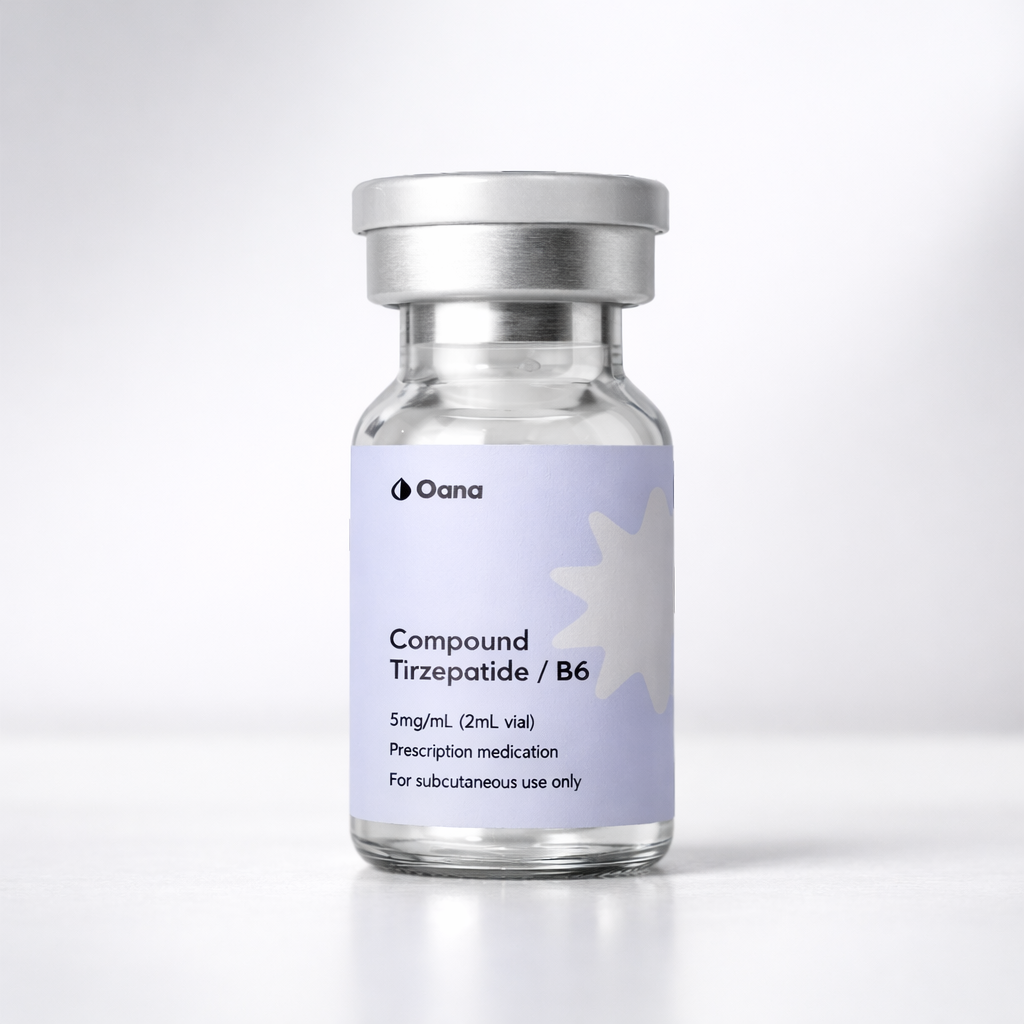
Tirzepatide is described in published medical literature as a dual GLP-1/GIP receptor agonist. The compounded tirzepatide dispensed through Oana is a compounded preparation that contains the same active ingredient. Compounded medications are not FDA-approved. A licensed physician may consider compounded tirzepatide for women whose PCOS symptoms are not adequately addressed by other options, depending on individual clinical circumstances.
Start My Health Intake →Information about the mechanisms of these medications, based on published medical literature.
Metformin is associated with activity on the AMPK pathway in the liver and muscles. It is FDA-approved for type 2 diabetes and is used off-label by physicians for PCOS-related insulin resistance.
Tirzepatide is described in published medical literature as a GLP-1 receptor agonist with effects on gastric emptying and satiety signaling. The compounded tirzepatide dispensed through Oana is not FDA-approved. Individual responses vary.
Tirzepatide is also described in published literature as a GIP receptor agonist. Discussion of fat metabolism mechanisms is based on published medical research about the active ingredient. Whether and how this applies to any individual patient is a clinical determination.
Whether a combination of medications is appropriate for any individual depends on her specific symptoms, health history, and clinical situation. A licensed physician will determine appropriate treatment after reviewing your health intake.
Research suggests that many women with PCOS experience insulin resistance, including women at a normal weight. The cycle of insulin and androgen interaction in PCOS is described in published medical literature as part of the condition's underlying biology. Treatment approaches vary based on individual symptoms and clinical judgment.
Different medications work through different mechanisms. A licensed physician will discuss what may be appropriate for your individual situation.
Starting medications typically involves an initial period of body adjustment. Your physician will provide specific dosing instructions based on your individual situation, if prescribed.
Individual responses to medications vary. Your physician will monitor your progress and may adjust treatment as needed.
Individual responses vary over time. Your physician can discuss expected progress and conduct ongoing monitoring as part of your care.
Long-term treatment is a partnership between you and your physician. Discuss your goals, progress, and any concerns during ongoing care.
These typically resolve within the first 2-4 weeks as your body adjusts. The ER formulation significantly reduces these compared to standard metformin.
Your provider will monitor bloodwork periodically. B12 supplementation may be recommended for long-term users.
These tend to lessen as your body adjusts over the first 2-4 weeks.
Not recommended during pregnancy. Patients with a personal or family history of medullary thyroid carcinoma or MEN 2 syndrome should not use compounded tirzepatide. Tell your provider about all medications you take. If prescribed.
Compounded medications have not been evaluated by the FDA for safety. Possible side effects may include but are not limited to those listed above. Report any concerning symptoms to your physician or to FDA MedWatch at 1-800-FDA-1088.
Treatment outcomes vary by individual. A licensed physician will discuss potential benefits, risks, and expected outcomes during your health intake review based on your specific health profile. Individual results are not guaranteed.
Start My Health Intake →Both options include free shipping, a one-time $20 doctor visit, and ongoing physician support. Cancel anytime. If prescribed.
Metformin and tirzepatide are different medications that work through different mechanisms. Whether one or both is appropriate for any individual depends on her specific symptoms, health history, and the clinical judgment of a licensed physician. Metformin is FDA-approved for type 2 diabetes (used off-label for PCOS). Compounded tirzepatide is not FDA-approved. Treatment decisions are made by a physician during your health intake review.
Individual responses to medications vary. Your physician can discuss expected timelines based on your specific situation during your health intake review. Individual results are not guaranteed.
Your Oana physician will review your full health history and determine whether a particular combination is appropriate for your individual situation. Discuss any concerns about drug interactions during your health intake.
Metformin ER is a daily oral tablet typically taken with food. Compounded tirzepatide is a weekly subcutaneous injection administered at home. Your physician will provide detailed administration instructions if either or both medications are prescribed.
If your current treatment isn't meeting your needs, your physician can review your situation and discuss whether other options may be appropriate. Treatment decisions are made by a licensed physician based on your individual circumstances.
Cost considerations are personal and depend on your individual situation. Your physician can discuss what may be clinically appropriate for you, and you can make a decision that fits your circumstances. Treatment decisions are made by a physician based on clinical factors, not commercial considerations.
Yes. Many women start with one medication and discuss other options with their physician over time. Your physician can adjust your treatment as your needs change.
The most common side effects are mild GI symptoms (nausea, bloating) from metformin and decreased appetite from compounded tirzepatide. Both typically resolve within 2-4 weeks. The extended-release metformin formulation reduces GI issues significantly. Discuss any concerns about side effects with your physician, who can provide individualized guidance.
It depends on your situation. Some patients use medications for a defined period, while others maintain treatment long-term. Your provider will work with you to find the right approach based on your goals and progress.
Metformin ER (extended release) releases the medication slowly over 8-12 hours, while standard metformin releases it all at once. The ER version causes significantly fewer stomach-related side effects, which is especially important when taking it alongside other medications.
Complete a 5-minute online health intake. A licensed provider will review your information within 1-2 business days.
Free shipping · Cancel anytime · No hidden fees · If prescribedNotes & citations
Note: Citation above references published meta-analysis research about GLP-1 receptor agonists combined with metformin in PCOS as a class. This research is not a direct study of Oana's compounded tirzepatide specifically. Compounded tirzepatide has not been independently evaluated by the FDA. Individual treatment decisions are made by licensed physicians based on individual patient circumstances.